 There is a subtle but important difference between funding Cancer Research UK and funding research into cancer. The former funds high earning executives, highly paid management, multiple expensive offices, and more. The latter does as it says and funds research into cancer.
And two months after we raised the question of how much of the funds raised via sponsorship of runners taking part in the Race for Life goes directly to fund research in cancer, and despite our prompting them for a reply several times, we still await a response.
The absence of any confirmation does not surprise us though. Cancer Research UK have form for not saying things, phrasing things cleverly, and sometimes simply inaccurate stories, in order to create a misleading impression of their events and where money raised through those events goes.
It is a fact that they have spent the best part of a quarter of a century spinning a range of different yarns as to who created the Race for Life and denying any recognition to the person who actually did.
Having been called out on these tales, they now take an official, and hypocritical, line of “not recognising anyone.” And why tell the truth when simply missing it out fits your agenda better?
For example, why tell people that none of their Race for Life entry fee funds research into cancer? Far better not to mention it at all and leave people with the impression it does through statements such as, “this is beating cancer.” How the entry fee “is beating cancer’ is anyone’s guess when none of it goes to any research. But let’s not tell anyone.
And then, rather than the (deliberate?) omissions, look out also for the cleverly phrased statements, such as the one we are seeking clarification on (so far, without success). The Race for Life website states that sponsorship raised goes to Cancer Research UK leading to questions as to what percentage actually finds its way to funding any research?
For there is a fundamental difference between going to Cancer Research UK and its high earning executives, its expensive central London and regional offices, etc., and actually funding research.
What percentage of the sponsorship, raised and donated in good faith, actually funds research?
In the absence of any reply, study Cancer Research UK’s form and draw your own conclusions.
In the Race 4 Truth, Cancer Research UK are lagging behind.
 Early in 1993, John Cowan was diagnosed with the Prostate Cancer which would eventually take his life. The diagnosis motivated John’s son, Jim, to create a fundraising event to support the fight against cancer.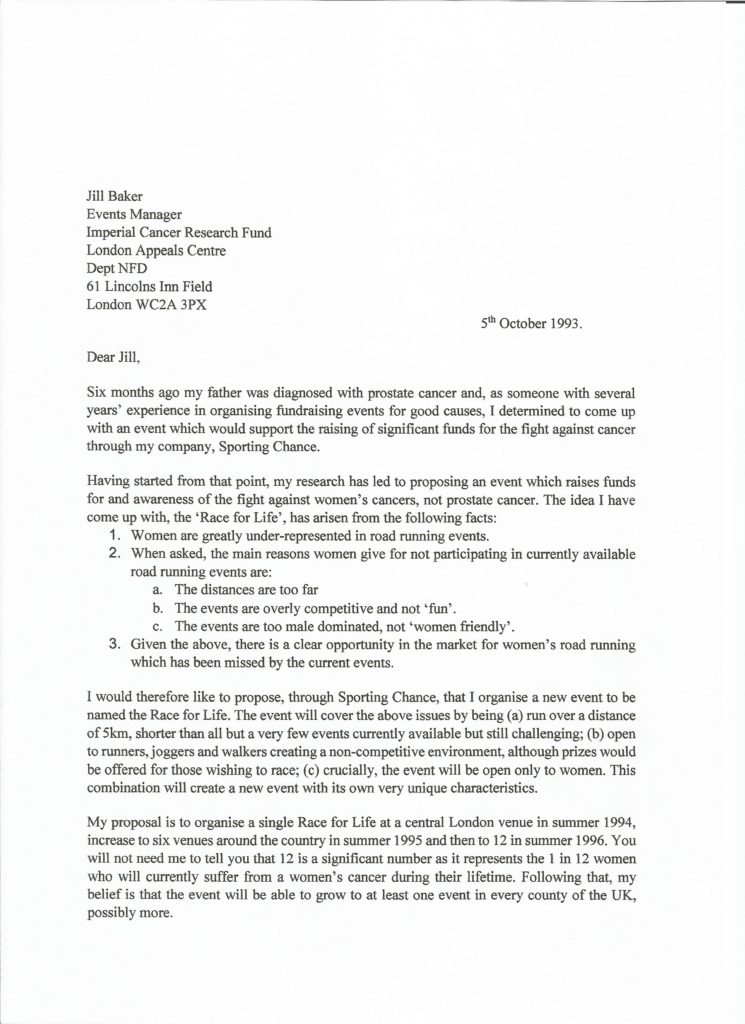
 Following a series of high profile scandals, confidence and trust in the UK’s charity sector recently hit an all time low. You might think that would be a wake up call to the sector but at Cancer Research UK the intention appears to be one of deliberately further undermining that public trust and confidence.
 Imagine creating a groundbreaking new fundraising event, one which goes on to raise over £1/2 Billion for the charity you shared it with and which changed the fundraising landscape in the UK for good, creating a type of event which has raised many times more than that for hundreds of charities.
 The National Council for Voluntary Organisations (NCVO) has been developing a set of principles that can act as a ‘code of ethics’ for the charity sector and is now consulting on a draft code.
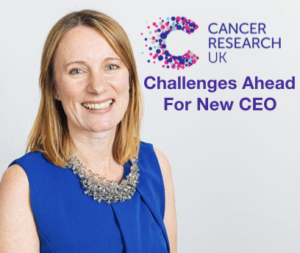 When Cancer Research UK’s new Chief Executive, Michelle Mitchell, takes up her post later this summer, she will face many of the same challenges facing all CEO’s, whether in the corporate or charity sector. Where is the organisation going? How will it maintain or increase growth? What will the broader economy mean to fundraising? And more, including understanding and improving public perceptions of the charity.
 Hypocrisy? Absolutely. For although the charity and its leadership refuse to recognise Jim Cowan, they have been more than happy over the years to
 The Race 4 Truth
  They Tweeted using Father’s Day as a marketing tool and calling on people to honour fathers affected by cancer while (still) ignoring Jim Cowan and denying him recognition for creating the event and in full knowledge of the fact that the inspiration behind Jim’s creating of the Race for Life was his own father’s cancer diagnosis in 1993. Hypocrisy?
 C
C And what of their Chairman, Professor Sir Leszek Borysiewicz, who was knighted in 2001 in recognition of his work. Where does he stand on recognising Jim Cowan for the creation of an event his charity has gained so much through? He refuses to recognise Jim at all. No, it is fine for others to recognise him but not for him to recognise Jim. Hypocrisy?
 The charity’s new Chief Executive Officer will be starting work soon. Michelle Mitchell already has an OBE so we know she is willing to accept recognition for her achievements. We can only hope that, unlike those who preceded her, she is not a hypocrite and will be keen to ensure recognition to all who merit it both within the organisation and without.
 On 19th June we published an article which asked; “were false claims about who created the Race for Life fraud?