The Race 4 Truth has highlighted the level of hypocrisy which runs through Cancer Research UK in previous articles. Their latest Annual Report highlights further just how deep the issue is.
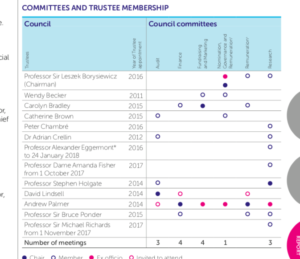
Despite the hypocrite in chief, former CEO Sir Harpal Kumar, having now left Cancer Research UK, we were interested to note the make up up of the organisations committees and trustee membership, as reported in their 2017-18 Annual Report (page 45).
The thirteen strong list includes three knights and one dame.
We don’t doubt those awards were deserved but we continue to wonder at the hypocrisy of an organisation whose leadership are happy to accept recognition for their own achievements and work but continue to refuse to recognise Jim Cowan, who created Cancer Research UK’s biggest fundraising vehicle, the Race for Life.
Over the years Cancer Research UK have created a range of different stories as to the creation of Race for Life. A former employee fraudulently claimed the event was her own creation, we assume supported by CRUK. And, when the lies and the misrepresentation of the truth were exposed, rather than doing the right thing and recognising Jim’s amazing creation, they instead opted for a corporate line of ‘not recognising anyone.’
This is still hypocrisy of the highest order. With so many in CRUK’s leadership happy to accept recognition, their refusal to recognise Jim is an indictment not only on the organisation’s leadership, but on the low/no integrity culture embedded throughout.
We call on Cancer Research UK to put right the wrongs of almost a quarter of a century and recognise Jim Cowan for the creation of an event which has raised so much for them, and which changed the fundraising landscape for all UK charities for good.
Further, we call on the new CEO, Michelle Mitchell (herself an OBE), when she starts her new role to begin by eradicating the deeply embedded hypocrisy in the organisation, thus starting to restore the integrity which has been absent for so long.
In the Race 4 Truth, Cancer Research UK are lagging behind.
 Cancer Research UK’s 2017-18 Annual Report claims “more than 80p from every £1” goes to funding research. However, a closer look reveals the figure is not an accurate one and omits certain income streams to paint a better picture than the reality.
 Here at the Race 4 Truth we have highlighted a number of concerns over the way Cancer Research UK deliberately misleads supporters, misrepresents facts, displays serious hypocrisy, and potentially supports fraud. We have gone as far as to question the culture of the organisation and its poor ethics and low integrity.
 There is a subtle but important difference between funding Cancer Research UK and funding research into cancer.
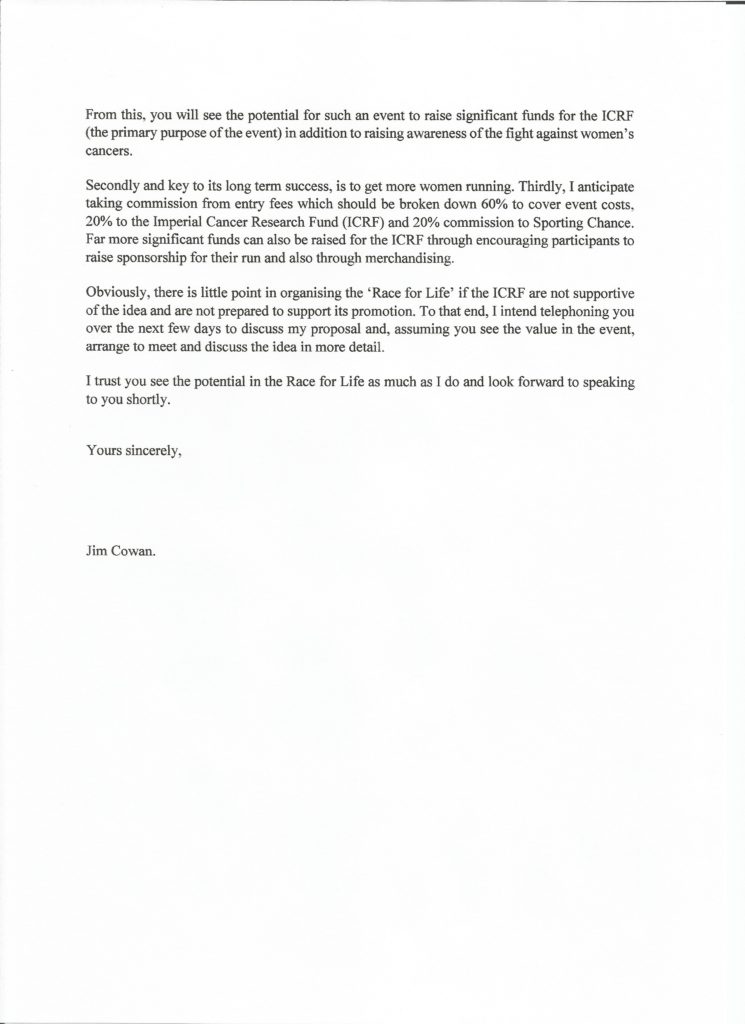
  Early in 1993, John Cowan was diagnosed with the Prostate Cancer which would eventually take his life. The diagnosis motivated John’s son, Jim, to create a fundraising event to support the fight against cancer.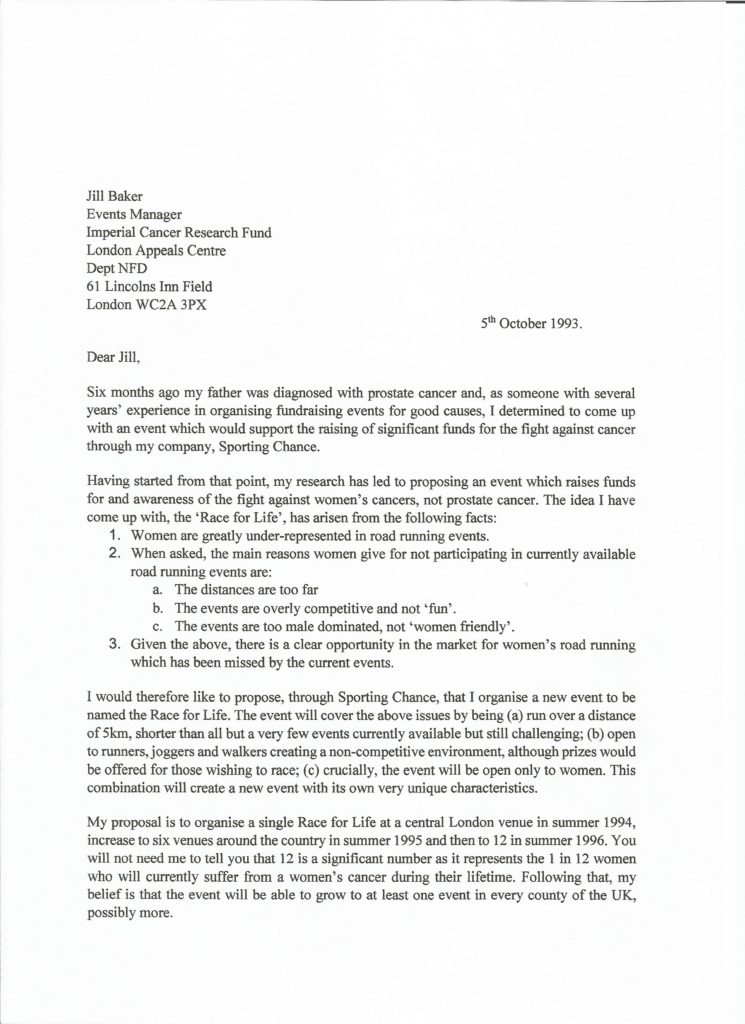
 Following a series of high profile scandals, confidence and trust in the UK’s charity sector recently hit an all time low. You might think that would be a wake up call to the sector but at Cancer Research UK the intention appears to be one of deliberately further undermining that public trust and confidence.
 Imagine creating a groundbreaking new fundraising event, one which goes on to raise over £1/2 Billion for the charity you shared it with and which changed the fundraising landscape in the UK for good, creating a type of event which has raised many times more than that for hundreds of charities.
 The National Council for Voluntary Organisations (NCVO) has been developing a set of principles that can act as a ‘code of ethics’ for the charity sector and is now consulting on a draft code.
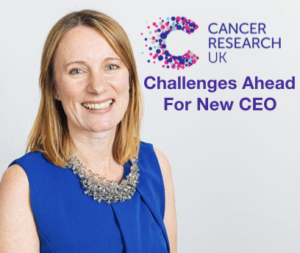 When Cancer Research UK’s new Chief Executive, Michelle Mitchell, takes up her post later this summer, she will face many of the same challenges facing all CEO’s, whether in the corporate or charity sector. Where is the organisation going? How will it maintain or increase growth? What will the broader economy mean to fundraising? And more, including understanding and improving public perceptions of the charity.
 Hypocrisy? Absolutely. For although the charity and its leadership refuse to recognise Jim Cowan, they have been more than happy over the years to